The CDC's STEADI program puts the number plainly: one in four people aged 65 and older falls each year, and more than 95% of hip fractures are caused by those falls. A fall is the event that most often turns an independent older adult into a dependent one. It is also, in the CDC's own words, preventable. This post covers what changes in the body that makes falls more likely, the steps that reduce the risk, and the specific place chiropractic care has alongside them — which is real but limited, and we'll say where the limits are.
What changes after 65
Balance is not one thing. It's the combination of three inputs — vision, the inner ear, and the position sense from joints and muscles — processed by the brain and executed by muscles fast enough to catch you. Every one of those degrades with age at its own pace. Vision loses contrast sensitivity. The inner ear's motion sensors thin out. Joints, especially in the feet, ankles, and spine, send less precise position information when they're stiff or arthritic. Muscles lose mass and, more importantly, lose speed — the ability to react in the fraction of a second between a stumble and a fall. Add medications that cause dizziness or drops in blood pressure on standing, and the margin for error narrows.
Two spinal problems belong on that list. Spinal stenosis, which is common after 60, can cause leg heaviness and numbness in the feet that impairs balance without the person realizing why. And a stiff, forward-bent posture moves the body's center of gravity ahead of the feet, which makes every step a small controlled fall.
The CDC's three steps
STEADI gives older adults three things to do: speak up, keep moving, and check your home and your eyes.
Speak up means telling your doctor if you've fallen, feel unsteady, or worry about falling — about half of older adults who fall don't tell anyone, and that's the information that triggers a medication review and a balance assessment. Keep moving is the one with the strongest evidence: the National Institute on Aging recommends a combination of aerobic, muscle-strengthening, and balance activities, and specifically notes that strengthening exercise helps older adults stay independent and prevent fall-related injuries. Tai chi, heel-to-toe walking, and standing on one foot with a chair nearby are the classic examples. Check your home and your eyes covers the rest: a vision exam at least yearly, and removing the loose rugs, poor lighting, and clutter that cause most falls at home.
Where chiropractic care fits — and where it doesn't
Chiropractic care is not a fall-prevention program, and we won't call it one. What it can address is the musculoskeletal contribution: stiff spinal and hip joints that reduce position sense, the forward posture that shifts the center of gravity, and the pain that keeps an older adult from doing the balance and strength exercise that actually reduces falls. A patient who can't walk fifteen minutes because of back pain can't do the exercise program; getting the back pain managed is upstream of the program.
For patients over 65 at our office, the seniors evaluation is different from a younger patient's. Bone density is asked about specifically, because osteoporosis changes what techniques are safe. An X-ray is more likely to be warranted. Adjustments use lower-force techniques, and the plan leans harder on mobility exercise and less on manipulation. And if the exam finds signs that a fall risk is coming from somewhere else — dizziness on standing, vision changes, a neurological finding — that's a referral to your physician, not something we manage.
Simple things that work
The exercises with the best evidence are unglamorous. From the AAOS and NIA guidance, and what we give patients:
- Sit-to-stand from a chair without using your hands, ten times, twice a day. This is leg strength and it is the single best predictor of fall risk you can train.
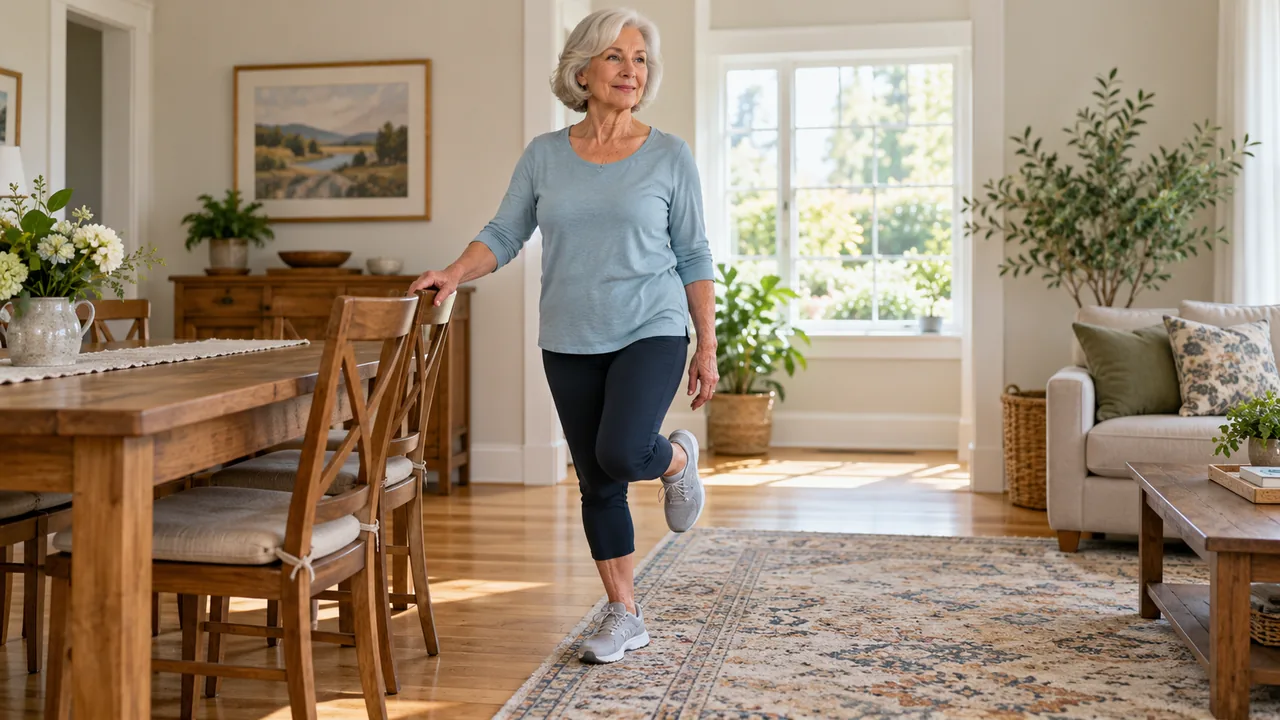
- Stand on one foot with a hand on the counter, 10 to 30 seconds each side. Progress by lifting the hand.
- Heel-to-toe walking along a hallway, hand near the wall.
- Walk daily. Aerobic activity keeps the whole system tuned, and walking is the most useful balance exercise there is.
- Core work that AAOS recommends for the back — gentle abdominal bracing and bridges — which also stabilizes the trunk over the feet.
Start with the chair nearby and a phone in your pocket. None of this should be done on a day you feel dizzy.
Stay upright, stay independent
If stiffness or back pain is keeping you from moving the way you need to, schedule an evaluation or call (407) 909-4788. Se habla español.
Frequently Asked Questions
- Is chiropractic care safe for someone with osteoporosis?
- It can be, with technique changes — low-force methods rather than thrusting adjustments. Tell us about your bone density before your first visit. Significant osteoporosis rules out some techniques entirely.
- I've fallen once. Does that mean I'll fall again?
- One fall roughly doubles the chance of another, which is why the CDC wants you to tell your doctor. It's a signal to act on, not a sentence.
- Can a chiropractor fix my balance?
- No. Balance involves vision, the inner ear, nerves, and muscles, most of which are outside chiropractic scope. We can address joint stiffness and posture that contribute, and help you get pain-free enough to do the exercise that does improve balance.
- Which medications increase fall risk?
- Sleep aids, some blood pressure medications, sedatives, and some antidepressants are common ones. That's a conversation for your physician or pharmacist, who can review the full list.
- Is walking with a cane a sign of giving up?
- It's a sign of good judgment. A cane or walker used correctly reduces falls. A physical therapist can fit one and teach the technique.
- How often should someone over 65 see a chiropractor?
- It depends on what's being managed. Many older patients with chronic back or hip stiffness do well with a visit every few weeks; others only need care during a flare. We reassess rather than set a fixed schedule.