
Holiday Travel and Your Back: Getting Through Long Drives, Flights, and Luggage Without a Flare-Up
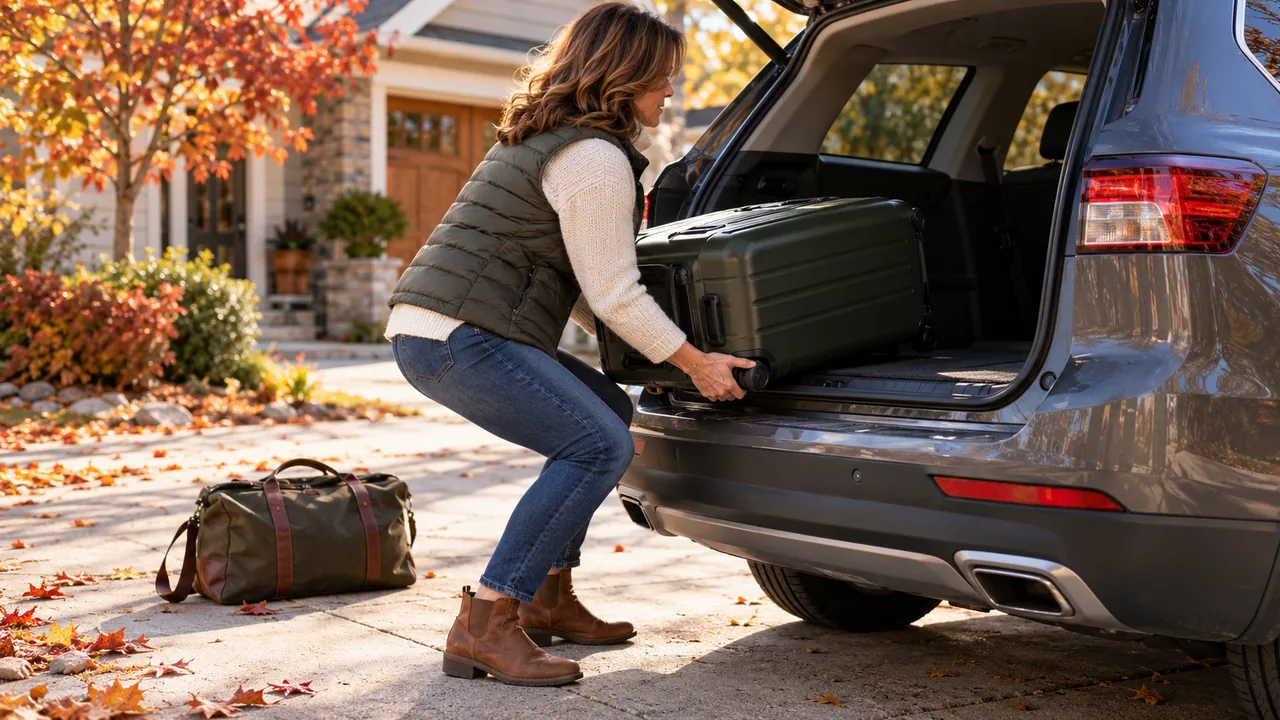
Every year, the week after Thanksgiving and the first week of January are two of the busiest in our office, and the story is usually the same: six hours in the car to see family, a suitcase hoisted into an overhead bin, three nights on a guest-room mattress, and a back that was fine before the trip and isn't now. None of that is inevitable. Here's how to set up the drive, get through a flight, handle the luggage, and — one thing that has nothing to do with your spine — avoid the travel risk the CDC wants everyone to know about.
The drive: set the seat before you leave the driveway
Most people drive in whatever position the seat was left in. For a trip to the grocery store that's fine; for six hours on I-95 it's where the trouble starts. Before you pull out:
- Bring the seat close enough that your knees stay slightly bent when the pedals are fully pressed, so you're not reaching with your leg and pulling your pelvis forward.
- Recline the backrest only slightly — around 100 to 110 degrees, not a lounge angle. Too far back forces your head forward and loads the neck.
- Support the lower back. If your seat has adjustable lumbar support, set it so you feel even contact from hips to shoulders. If it doesn't, MedlinePlus recommends a small pillow or rolled towel behind the lower back for long drives — it's the single cheapest fix on this list.
- Set the headrest so its top is level with the top of your head and it nearly touches the back of your skull. That's a neck-injury protection if you're rear-ended, not a comfort setting.
- Empty your back pockets. Sitting on a wallet tilts the pelvis for hours.
Then stop. MedlinePlus is specific: on a long drive, stop and walk around every hour. Not at the next state line — every hour. Two minutes of walking resets the muscles that have been holding one position. And don't lift anything heavy right after the drive, when those muscles are stiff and your discs have been loaded in one posture for hours.
The flight: the neck is the problem, and so are the veins
Economy seats put your head forward and your lower back unsupported — the same posture we described in our post on tech neck, held for the length of the flight. A rolled sweater behind the lower back helps. Looking down at a phone or tablet for three hours does not; hold the screen up or take breaks from it.
The bigger flight risk isn't musculoskeletal. The CDC warns that sitting still in a confined space for more than about four hours — by air, car, bus, or train — raises the risk of a blood clot in the deep veins of the leg. Part of a clot can travel to the lungs, which is rare but can be fatal. The CDC's advice: choose an aisle seat so you can get up, walk every two to three hours, and while seated, raise and lower your heels and toes and tighten and release your leg muscles. If you have added risk factors — a previous clot, recent surgery or injury, pregnancy, hormone medication, obesity, cancer treatment, or age — talk to your doctor before the trip about compression stockings or other measures. A swollen, painful calf during or after travel is a reason to see a doctor, not a chiropractor.
The luggage: this is where backs actually get hurt
The car ride makes your back stiff. The suitcase is what injures it — lifted with a twist, from an awkward height, when you're tired. The American Academy of Orthopaedic Surgeons covers it plainly: stand alongside the luggage, bend at the knees, grasp the handle, and straighten up. Lift with your legs, not your waist. If you need to turn, pivot your feet in the direction you're going rather than twisting your trunk with the load in your hands. Keep the bag close to your body while moving it.
Two specific traps. The trunk of a car makes you reach and lift over the bumper at the same time; slide the bag to the edge first, then lift. And overhead bins put a 30-pound bag above your head, which is the worst position for the shoulders and neck — lift it to chest height first, get your hands underneath, then push up. If you can check the heavy bag, check it.
The guest bed and the couch
Three nights on a mattress that isn't yours is a common flare-up trigger, and there isn't much to do about the mattress. There is something to do about how you use it: a pillow between the knees if you sleep on your side, or under the knees on your back, keeps the pelvis level. If the bed is a pullout couch with a bar under your back, ask for the floor with a couple of blankets under you; a firm flat surface is better than a sagging one.
If your back is already a problem
If you're managing sciatica, a disc problem, or chronic low back pain, a long trip is a load your spine hasn't been handling day to day. Book a visit the week before you leave rather than the week after. An adjustment and a short set of exercises to do on the road — we'll tailor them to your trip — are a reasonable way to go in with margin. Our post on how often to see a chiropractor covers how pre-trip visits fit into ongoing care.
Go in with margin, not on fumes
If you've got a long trip coming up and a back that's been complaining, schedule a visit before you go or call (407) 909-4788. Se habla español.
Frequently Asked Questions
- Is it better to drive or fly for my back?
- Neither is inherently worse. Driving lets you control the seat and stop when you want; flying is usually shorter but the seat is worse. Whichever you choose, moving every hour or two matters more than the mode.
- Should I wear a back brace for a long drive?
- Generally no, unless a provider recommended one. A lumbar cushion supports the curve without weakening the muscles the way prolonged bracing can.
- I threw my back out lifting a suitcase. What now?
- Keep moving gently — short walks rather than bed rest — and use ice for the first day or two. If pain radiates down a leg, or you have numbness, weakness, or bladder or bowel changes, seek care promptly. Otherwise, book with us when you're home.
- Can I get a chiropractic adjustment while I'm traveling?
- Yes; chiropractic is licensed in every state. If you see someone on the road, tell them about any recent imaging or care so they aren't starting cold.
- What about kids in car seats and boosters on long trips?
- The same rule applies: stop every hour or two and let them move. Kids don't get clots the way adults do, but they do get restless and stiff.
- Are compression socks worth it for a long flight?
- The CDC says some people at higher risk may benefit from graduated compression stockings. For most healthy travelers, walking and calf exercises are the main defense. Ask your doctor if you have risk factors.