
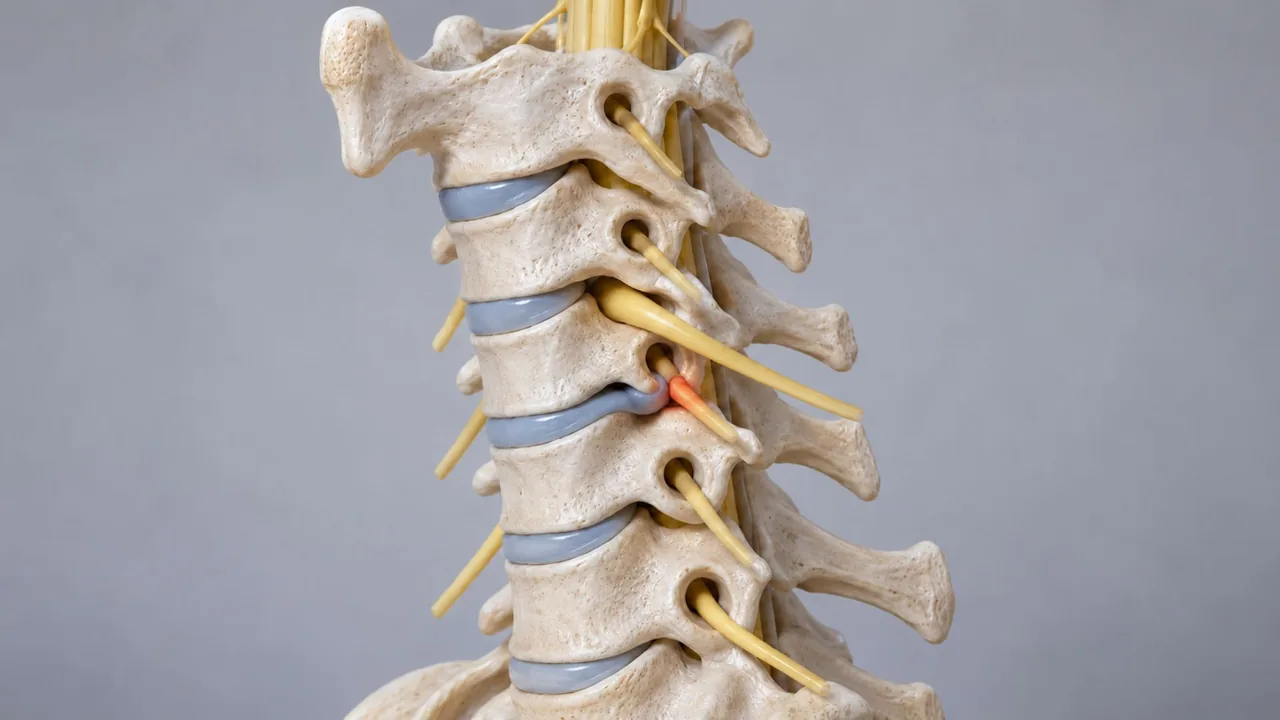
"Pinched nerve" is what patients say. It's a useful phrase, but the National Institute of Neurological Disorders and Stroke lists it in its glossary as an informal term, not a medical one — an umbrella for a nerve being compressed, constricted, or stretched somewhere along its path. Where along that path is the whole question, because a nerve pinched in the neck, a nerve pinched in the low back, and a nerve pinched at the elbow are three different problems with three different approaches.
This post walks through the common locations, how the symptoms point to each, and what conservative care at our office looks like when the source is the spine.
Location one: the neck (cervical radiculopathy)
The medical name for a pinched nerve in the neck is cervical radiculopathy. The American Academy of Orthopaedic Surgeons describes it as a nerve compressed or irritated where it branches away from the spinal cord, producing pain that radiates into the shoulder and arm along with weakness and numbness. In older adults the usual cause is degenerative change — disc thinning and bone spurs narrowing the opening the nerve passes through. In younger people it's more often a herniated disc, sometimes after a specific injury, sometimes with no clear trigger.
The tell is the pattern. Each cervical nerve root supplies a specific strip of the arm and hand and a specific set of muscles, so the symptoms follow that map: pain and tingling down the outside of the arm into the thumb suggests one level; into the middle finger, another; into the ring and little fingers, a third. The Cleveland Clinic notes that neck movements — especially extending the neck or turning toward the painful side — often reproduce the arm symptoms, which is one of the things we test for.
Location two: the low back (lumbar radiculopathy)
The same problem in the lumbar spine produces symptoms down the leg. When the sciatic nerve roots are involved, it's sciatica; the cause is usually a herniated disc in younger patients and spinal stenosis — narrowing of the canal or the nerve openings — in older ones. Again the pattern points to the level: pain down the back of the leg into the sole of the foot, the outside of the leg into the big toe, or the front of the thigh each implicates a different root. Sitting, bending, and coughing often aggravate disc-related compression; walking and standing often aggravate stenosis.
Location three: not the spine at all
Nerves can be compressed anywhere along their length. The AAOS lists the common mimics of cervical radiculopathy: ulnar nerve entrapment at the elbow (cubital tunnel), and median nerve entrapment at the wrist (carpal tunnel). In the leg, the sciatic nerve can be irritated where it passes the piriformis muscle in the buttock, and the peroneal nerve at the outside of the knee. These produce numbness and tingling in a nerve's territory without neck or back pain, and they don't change with spinal movement — which is how the exam separates them. We covered the sorting process in detail in our post on numbness and tingling.
The symptoms that need urgent evaluation
Most pinched nerves are painful, not dangerous. A few presentations are, and they need an emergency department rather than an appointment: progressive weakness in an arm or leg; numbness spreading rather than staying put; loss of bladder or bowel control or numbness in the "saddle" area; weakness or numbness on both sides at once; or symptoms that started after a fall or crash. Those can indicate spinal cord compression or a large disc herniation that needs imaging and possibly surgical evaluation the same day.
What conservative care involves
The AAOS states that in most cases, cervical radiculopathy responds well to conservative treatment and does not require surgery. The same is broadly true of lumbar radiculopathy without red flags. That's the space chiropractic care occupies.
At Mattia Spinal Care, nerve impingement care begins with locating the level. Dr. Nazario maps sensation, tests reflexes and strength by nerve root, and uses positional tests to see what reproduces and what relieves the symptoms. Imaging is ordered when the exam suggests a finding that would change the plan. Care may then include:
- Adjustments or mobilization to the involved segments, using techniques and positions chosen to avoid loading the irritated nerve
- Spinal decompression for disc-related compression in the neck or low back
- Soft-tissue work, including Active Release Technique, for muscles that are guarding or contributing to the entrapment
- Nerve-gliding and directional exercises to do at home, with specific instructions on the movements to avoid while the nerve is irritated
- Advice on positioning — how you sleep, sit, and work — because a compressed nerve is highly sensitive to sustained posture
Progress is measured by whether the symptoms retreat toward the spine (a good sign, called centralization) or continue to travel outward. If they're not improving within a reasonable window, or if weakness appears, we refer for further evaluation rather than continuing the same plan.
Find the level, then treat it
If you have pain, tingling, or numbness travelling down an arm or leg, schedule an evaluation or call (407) 909-4788. If any of the urgent symptoms above apply, go to the ER first. Se habla español.
Frequently Asked Questions
- How do I know if my pain is a pinched nerve or a muscle?
- Nerve pain radiates along a defined path, often with tingling, numbness, or weakness, and is reproduced by specific positions. Muscle pain is usually local and aching. An exam can tell them apart reliably.
- Can a chiropractor treat a pinched nerve?
- When the nerve is compressed at the spine and there are no red flags, yes — that is standard conservative care. When the compression is at the elbow or wrist, conservative care may still help. When there are red flags, medical evaluation comes first.
- How long does a pinched nerve take to heal?
- Many improve over weeks with conservative care; some take a few months. The timeline depends on the cause — a herniated disc and a bone spur behave differently — and on how quickly the aggravating load is reduced.
- Will I need surgery?
- Most people don't. The AAOS says most cervical radiculopathy resolves without it. Surgery is considered when conservative care fails, when weakness progresses, or when imaging shows severe compression.
- Should I get an MRI?
- Not automatically. MRI is ordered when exam findings suggest something that would change treatment, when red flags are present, or when conservative care isn't working.
- Can a pinched nerve cause permanent damage?
- Prolonged severe compression can cause lasting weakness or numbness, which is why progressive symptoms are treated as urgent. Most cases treated early recover fully.