If you've searched for a prenatal chiropractor, you've seen the phrase "Webster certified" — and, on many of those pages, the claim that the Webster Technique turns breech babies. The first half is a real credential. The second half is a claim the organization that teaches the technique does not endorse. This post explains what the Webster Technique is, using the ICPA's own definition, what it's actually for, and how it fits into pregnancy care at our office.
The definition, from the source
The International Chiropractic Pediatric Association developed and certifies the Webster Technique. Its official description is a specific sacral analysis and diversified adjustment, taught for use throughout pregnancy to reduce the effects of sacral subluxation and sacroiliac joint dysfunction, and also for any weight-bearing individual regardless of age or sex.
In plain terms: it's a way of assessing the sacrum and pelvis for restricted movement and imbalance, followed by a gentle adjustment and release of the related soft tissues. It is not a special procedure reserved for pregnancy. It is applied in pregnancy because the pelvis is under unusual load and the assessment is well-suited to it.
What the ICPA says it is not
The ICPA published a position paper on the technique whose conclusion is unambiguous: the association holds that Webster is an assessment and adjustment for weight-bearing individuals used to enhance neuro-biomechanics, and it does not endorse the use of the technique as a treatment for fetal malposition or in-utero constraint.
That matters because "turns breech babies" is one of the most common claims on prenatal chiropractic websites. Some practitioners report that babies of Webster patients have moved to a head-down position; the ICPA's own framing is that the technique addresses the mother's pelvic mechanics, and whatever the baby does is not a treatment outcome anyone should promise. We don't promise it. If you have a breech presentation, that conversation belongs with your obstetric provider.
Why pregnancy is hard on the pelvis and low back
The American College of Obstetricians and Gynecologists describes the mechanism in its back pain during pregnancy FAQ: the expanding uterus shifts your center of gravity, stretches and weakens the abdominal muscles that support the spine, changes your posture, and adds load to muscles and joints — which is why the back often feels worse at the end of the day. Pregnancy hormones that loosen ligaments in preparation for birth also contribute, and ACOG notes the pain frequently lingers for months after delivery.
The sacroiliac joints — where the sacrum meets the pelvis on each side — take much of that load. When one side moves less than the other, the result is often one-sided low back or buttock pain, pain that shifts with position, difficulty rolling over in bed, or sciatic-type pain down one leg. Those are the complaints the Webster assessment is built to evaluate.
What a Webster visit involves
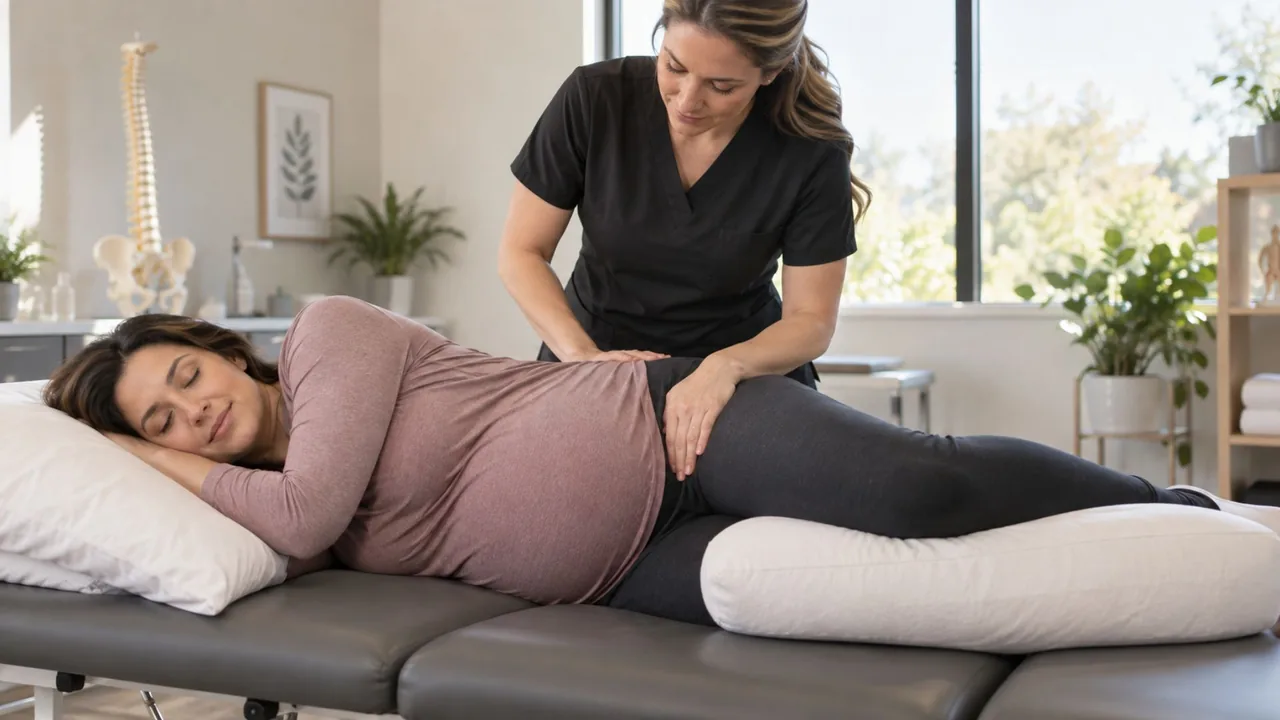
The assessment starts with you lying face down on a table designed for pregnancy — the abdominal section drops away so there's no pressure on the belly. Dr. Nazario checks sacral and pelvic alignment and compares how each leg moves toward the buttock; restricted motion on one side points to the sacroiliac joint involved. The adjustment to the sacrum is specific and low-force, and it's followed by a gentle release of the round ligament and related soft tissue at the front of the pelvis. There is no thrust to the abdomen and nothing is done to the baby.
Most patients are on the table for a few minutes for the technique itself. The rest of the visit is the same as any prenatal chiropractic appointment: a check of the rest of the spine, and practical advice on positioning, sleep, and movement for the stage you're in.
Who it's for — and who should talk to their OB first
Webster is appropriate at any stage of pregnancy for patients with pelvic or low back pain, pelvic asymmetry, or discomfort with walking and turning. We coordinate with your obstetric provider, and we ask you to check with them first if you have a high-risk pregnancy, vaginal bleeding, placenta previa, preeclampsia, or any condition they've told you to be cautious about. ACOG's general advice — talk to your ob-gyn before starting or changing an activity program in pregnancy — applies to chiropractic care too.
Back and pelvic pain don't have to be part of the deal
If pregnancy has brought low back, pelvic, or sciatic pain, schedule a prenatal evaluation or call (407) 909-4788. Our earlier posts on the benefits of chiropractic during pregnancy and the role of chiropractic in pregnancy cover the broader picture. Se habla español.
Frequently Asked Questions
- Is the Webster Technique safe during pregnancy?
- It's a low-force sacral adjustment with no pressure on the abdomen, designed for pregnant patients. As with any care in pregnancy, tell your obstetric provider you're receiving it, and don't start if they've advised against manual therapy for your situation.
- Does the Webster Technique turn a breech baby?
- The ICPA, which teaches and certifies the technique, states it does not endorse Webster as a treatment for fetal malposition. It addresses the mother's pelvic mechanics. Breech presentation is a conversation for your OB.
- When in pregnancy can I start?
- The ICPA teaches it for use throughout pregnancy. Many patients come in the second or third trimester when pelvic pain starts; earlier is fine if you're having symptoms.
- How is it different from a regular chiropractic adjustment?
- It's a specific assessment of the sacrum and sacroiliac joints plus a targeted adjustment and soft-tissue release. A general visit may include the same areas, but Webster is the standardized version.
- Can it be done after the baby is born?
- Yes. The technique is for any weight-bearing person, and the postpartum pelvis often benefits from the same assessment.
- Is Dr. Nazario Webster certified?
- Dr. Nazario is trained in the Webster Technique through the ICPA and Mattia Spinal Care is an ICPA supporting member. Ask us about credentials at your first visit — we'd rather you ask than assume.